Create, Dare, Be Passionate!


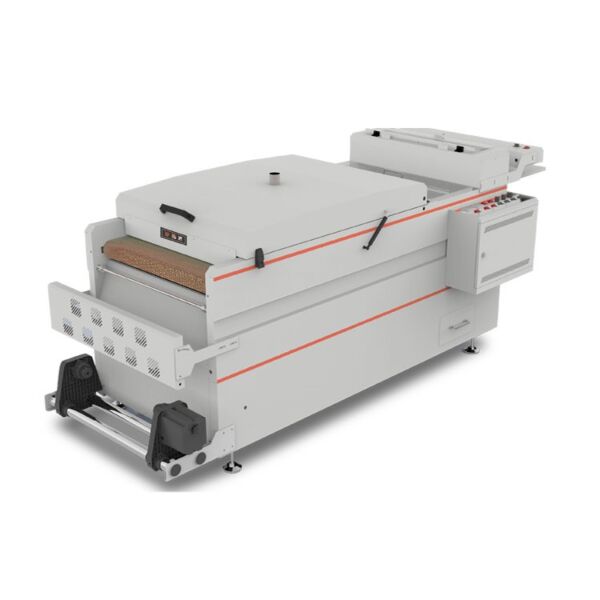


CT600s 60cm Ultra Fast Powder and Drying Sprayer - For 4-head DTF printers
7 980,00 € 6 650,00 €
Availability: Delivered within 1 to 3 days
SKU
ZHS_H6501
Discover one of our latest innovations: the powder applicator dedicated to DTF (Direct To Film) printing!
The DTF technique is as simple as its name suggests and involves just a few steps. Once your image is printed on the film, apply a layer of hot melt powder before drying and pressing it.
Thanks to this powder applicator, create high-quality markings at a lower cost! With a width of up to 60cm, it's suitable for all formats! It allows you to apply powder evenly and without gaps on your film. This is the fastest and most efficient machine on the market.
This powder applicator is recommended for 4-head DTF printers!
Product advantages:
- Universal compatibility
- Simple to use and requires less labor
- No cutting required
- No waste thanks to the powder collector
- No border
- Features a heating plate to dry the powder after application.
This product is available for pre-order! So don't wait any longer and be the first to equip yourself with DTF gear!
This item cannot be shipped via express delivery. Please do not select this shipping method. Delivery may take 4 to 5 business days.
This item cannot be shipped via express delivery. Please do not select this shipping method. Delivery may take 4 to 5 business days.
Features :
Package dimensions: 2400 x 1200 x 1136 mm
Machine dimensions (heating plate folded): 2306 x 1092 x 1102 mm
Machine dimensions (heating plate unfolded): 2806 x 1092 x 1102 mm
Machine weight: 300 kg Machine
weight: 210 kg Power supply
: 220V - 39A
Maximum power: 6.8 kW
Power consumption: 3 kW - 6.8 kW

The DTF (Direct-to-Fly) technique is as simple as its name suggests and involves just a few steps. The concept is straightforward: print onto a film and transfer it directly onto fabric. Its main advantage is the ability to print on any type of textile. Whether it's polyester, cotton, silk, or synthetic fibers, the DTF printing technique will adapt.
One of the strengths of DTF printing is that it doesn't require significant financial investment or any special prerequisites. Whether you're familiar with digital printing and want to switch to DTF printing to diversify your business, or you're starting from scratch, the necessary equipment will remain the same:
- Direct-to-film printer – These printers are often called modified DTF printers. They feature basic 6-color ink tanks, like the Epson L1800, etc. This offers convenient operation because DTF CMYK inks can be used in standard CMYK tanks, while the LC and LM tanks can be filled with white DTF inks. The rollers used to feed the page are also removed to prevent "liners" on the white layer printed on the DTF film.
- Films – PET films are used in the DTF printing process. These films differ from those used in screen printing. They are approximately 0.75 mm thick and offer superior transfer capabilities. In the market, they are often referred to as DTF transfer films. DTF films are available in cut sheets (suitable for small-scale applications) and rolls. Another classification of PET films is based on the type of peeling performed after the transfer. Based on temperature, there are two main types: hot peel films and cold peel films.
- Software – Software is a crucial part of the process. Printing characteristics, ink color performance, and the final print performance on fabric after transfer are determined by the software. For DTF printing, specialized RIP software capable of handling CMYK and white inks is required. Color profiling, ink levels, droplet size, and other factors contributing to optimized print results are all governed by the DTF printing software.
- Hot Melt Adhesive Powder - DTF printing powder is white and acts as an adhesive material that bonds the colored printing pigments to the fabric fibers. Different grades of DTF hot melt powder are available, specified in microns. The appropriate grade should be selected based on the requirements.
- DTF printing inks – These are pigmented inks specifically designed for this technique and are available in cyan, magenta, yellow, black, and white. The white ink is a special component that is deposited onto the film, onto which the colored design is printed.
- Automatic powder agitator - It is used to apply powder evenly and also to remove excess powder.
- Curing oven – It is essential to use a small industrial oven to melt the hot melt powder applied to the transfer film. A heat press can be an alternative for this operation, but it must be used in non-contact mode.
- Heat press - The heat press is used to adhere the printed image from the film to the fabric. It can also be used to heat the hot melt powder onto the DTF film, as explained previously.
Printing Steps
Step 1 - Printing on Film
Instead of using regular paper, insert the PET film into the printer trays. You must configure your software to print colors first. The white layer will be printed over the colors on your PET film. It's also important to remember that the print on the film must be a mirror image of the actual image that will appear on the fabric.
Step 2 - Powdering
This step involves applying the hot melt powder to the film containing the printed image. The powder must be applied evenly while the print is still wet. Be sure to remove any excess powder. A simple way to ensure this is to hold the film by its short edges so that its long edges are parallel to the ground (landscape orientation). Pour the powder down the center of the film from top to bottom so that it forms a mound approximately one inch thick in the center, from top to bottom. Retrieve the film with the powder and fold it slightly inward so that it forms a shallow U shape with the concave surface facing you. Now, very gently shake the film from side to side so that the powder spreads slowly and evenly across the entire surface. One alternative is to use automated agitators available for commercial setups .
Step 3 - Melt the Powder
This can be done in several ways. The most common method is to place the film with the printed image and the applied powder in a curing oven and heat it. If this is not possible, use a heat press and bring the top of the press close to the film without touching it. There should be a gap of approximately 4 to 7 mm between the film and the top plate of the heat press. A piece of wire can be used to secure the top of the press so that it does not completely close over the film and leaves the necessary space. For best results, it is strongly recommended to follow the manufacturer's specifications for melting the powder. Depending on the powder and equipment, heating typically takes 2 to 5 minutes at a temperature of around 160 to 170 degrees Celsius.
Step 4 - Pre-pressing:
This step involves pre-pressing the fabric for 2 to 5 seconds. This flattens the fabric and also ensures it is dehumidified . Pre-pressing allows for optimal image transfer from the film to the fabric.
Step 5 - Transfer:
This is the core of the DTF printing process. The PET film with the image and melted powder is placed onto the pre-pressed fabric in the heat press. This process is also called "curing." Curing is carried out at a temperature of 160 to 170 degrees Celsius for approximately 15 to 20 seconds.
Step 6 - Cold Peeling:
It is important that the fabric and the now-adhered film cool to room temperature before removing the film. Once the film has cooled, it must be peeled off the fabric.
Step 7 - Post-pressing
This is an optional but highly recommended step for best results. It allows for improved performance such as wash and rub resistance. In this step, the textile with the transferred design is pressed in the heat press for approximately 10 to 15 seconds.
Advantages of DTF:
- Works with almost all types of fabrics
- No pretreatment required
- Excellent wash resistance
- The fabric has a very light feel
- The process is faster and less tedious than DTG printing
Compared to dye-sublimation printing, the color vibrancy is less intense.
Créadhésif currently offers high-quality DTF inks compatible with most DTF printers. Our inks are particularly renowned for their ability to bring out even the most delicate shades on both light and dark fabrics. White ink provides the appropriate density for printed colors with optimal ink consumption.
Generally speaking, DTF printing eliminates virtually all the limitations often encountered with other textile printing techniques. The versatility of the textiles that can be processed is a significant advantage. Since pretreatment is not essential, the overall printing cost is often reduced, resulting in a higher profit margin. In conclusion, the DTF printing process can be considered an efficient and economical way to produce fabrics.
| Shipping | Delivered within 1 to 3 days |
|---|---|
| Features |
Write your own review